

When someone in Barcelona tells me they want to “sell their part” of a flat, they usually blend two deals: the cuota that stands in their name, and a full sale of the flat with the money split afterwards. Catalan law lets you dispose of your share. That power does not become a sale of 100% of the property, and it does not, by itself, clear a mortgage, occupation problems or tax.
You may alienate your right in the ordinary undivided community (comunidad ordinaria indivisa), the regime people usually call proindiviso. What leaves your name is a percentage of ownership, not a bedroom carved out of the floor plan. If the buyer is an outside third party, the other co-owners hold a Catalan preferential acquisition right (dret de tanteig i retracte). Tax follows that fork: selling the share is not the same as extinguishing the condominium so one person keeps the flat.
Important notice: This article is informational on the civil and tax framework usual in Catalonia and Barcelona. It is not individualised legal, tax, registry or mortgage advice. Before you notify, sign or award title, review your case with a lawyer, notary, ATC, AEAT or IMH and with an up-to-date land registry extract (nota simple). Rules and guidance checked with access on 15 November 2026; consolidated texts may be updated.
What you are actually selling: the share, not the whole flat
In everyday speech we say proindiviso. In the Catalan Civil Code the proper regime is the ordinary undivided community: there are as many rights as co-owners, and each right fixes the cuota in use, enjoyment, income, expenses and liabilities. Shares are presumed equal unless proved otherwise.
That cuota is not “your bedroom” or a slice of façade. It is a portion of the same right over the same flat. When you say you want to sell your part, the usual object is that proportional right, not a home cut into physical pieces.
At a purchase table the difference shows up fast. Disposing of the community’s object (selling the flat at 100%) needs unanimity of the co-owners, under Book Five itself. Disposing of your own share is a different power. If co-ownership came from an inheritance and what you really want is to sell the whole flat among siblings, use another guide: siblings who inherit an apartment in Barcelona. If acceptance or registration of the inheritance is still pending, start with inheriting an apartment in Barcelona.
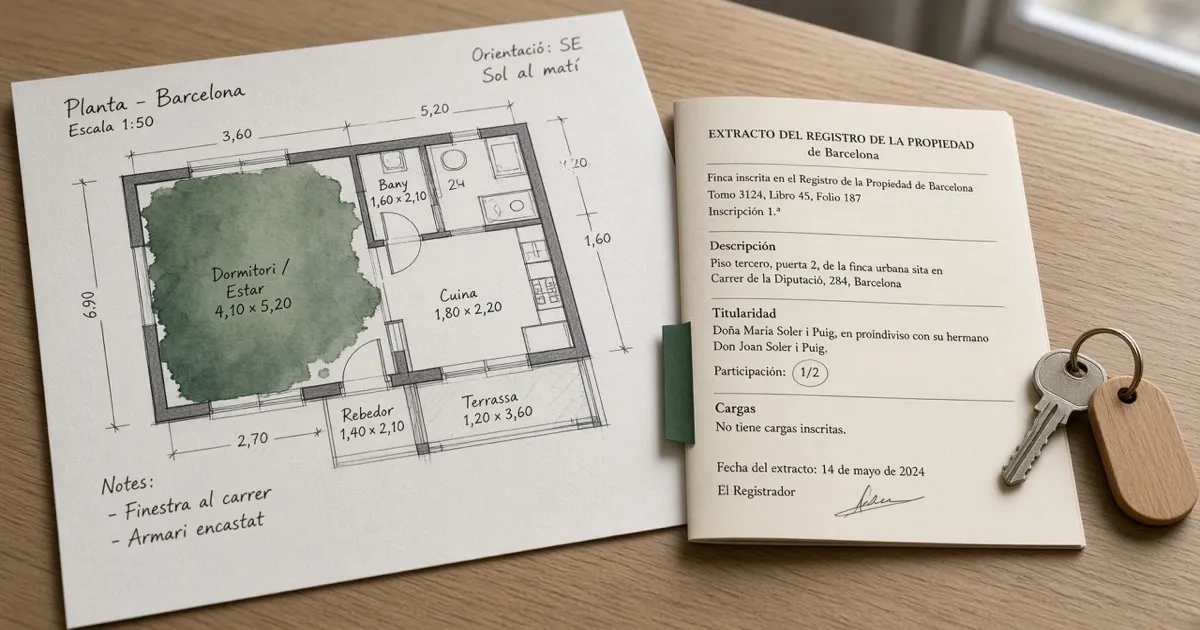
Before you set a price or hunt for a buyer, request a nota simple on the Registrars’ electronic portal. You will see title, the extent of rights and any limitations. Without that paper you are negotiating blind.
Yes, you can dispose of your share in Catalonia
Clients ask this almost every week: do I need the others’ “yes” to sell my percentage? Under Catalan civil law, each co-owner may freely dispose of their right in the community, alienate it and encumber it. Article 552-3.1 of the Catalan Civil Code says so in plain terms.
The co-owners’ consent is not the civil requirement to alienate your own share. Unanimous consent is the requirement to sell the whole flat. You can transfer your part; you cannot, through that route alone, decide the entire property.
Do not confuse that with the family home. In Catalonia, art. 231-9.1 of Book Two of the CCC requires the other spouse’s consent or court authorisation when the disposition compromises the use of the family home, including if it concerns an undivided cuota; without that, the act may be voidable at the other spouse’s instance, not void as of right (sections 2 and 3 set time limits, standing and cases in which the act remains effective). A stable partnership refers to the same regime under art. 234-3.2. That spousal or partnership consent is distinct from co-owner unanimity to sell 100% of the property.
For contrast, the Spanish Civil Code also recognises in article 399 that each co-owner may alienate, assign or mortgage their part. For a flat in Catalonia, the primary regime in this guide is Catalan Book Five, not the clock or mechanics of common Spanish law.
Hold these two limits from day one:
- If you sell to an outside third party, Catalan tanteo (pre-emption) and, where relevant, retracto (redemption) are triggered.
- If you sell to another co-owner, the preferential mechanism in 552-4.1 does not cover sales between co-owners (it is framed for “third persons outside the community”), but taxes, the mortgage and how the deal is classified still matter.
Selling your share also does not wipe your personal debt to the bank, and it does not guarantee exclusive possession for the buyer.
If the buyer is a co-owner or a third party: tanteo and retracto
Buying out by another name already on the registry extract is not the same as selling to a stranger.
Branch A: the buyer is already a co-owner
If you transfer your share for value to someone who already belongs to the community, article 552-4.1 of the Catalan Civil Code speaks of third persons outside the community. That legal preference of tanteo / retracto is not the case that provision regulates for a sale between co-owners. You still need to classify whether what you sign is a sale of a participation or an extinction/award with compensation: the tax changes.
Branch B: the buyer is an outside third party
If the onerous transfer is to an outside third party, the other co-owners have, unless otherwise agreed, a right of tanteo for the same price or value and on the same terms, under article 552-4 of the Catalan Civil Code. You must give formal notice of the decision to transfer and its circumstances; tanteo may be exercised within one month of that notice.
If there is no notice, or if the transfer goes through at a price or on terms different from those notified, tanteo carries retracto. That retracto may be exercised within three months from when the others learn of the transfer and its circumstances, or from registration of the transfer in the relevant registry (same 552-4.2). If several co-owners want to exercise it, they take it in proportion to their rights. On immovable property, exclusion or advance waiver is only valid in a public deed.
Three co-owners at one third each; one sells their 1/3 to a fund or an outside individual. That move triggers 552-4. If the buyer is one of the other two co-owners, the preference in 552-4.1 is not the same case.
Do not use the Spanish Civil Code’s 9-day clock in Barcelona. As a contrast, the common Spanish Civil Code regulates a co-owners’ retracto exercisable within nine days of registration or knowledge (arts. 1522 and 1524). In Catalonia the primary frame is 552-4: one month of tanteo after formal notice and three months of retracto if notice is missing or the terms change. Mixing both clocks is one of the most repeated mistakes online.
Skipping notice, or signing a different price than the one notified, is not a small formal slip. It opens retracto and can unwind a deal already closed with the third party.
Ending the condominium or selling the share: two different deals
Families often arrive at the notary convinced that “one keeps the flat” and “the other is paid their part” equals selling a percentage to a stranger. Civilly and fiscally it does not.
In extinction of the condominium (extinción de condominio) the community on that asset must disappear: the property is awarded so that co-ownership ends and whoever leaves receives compensation. If co-owners remain in proindiviso after the deal, the tax authority treats it as a share transfer subject to TPO, not as extinction for AJD purposes (binding ruling DGT V1020-26). In a share sale the community continues; only the co-owner changes. That fork drives ITP/AJD, plusvalía and which risks you still carry.
According to the Catalonia Tax Agency (ATC), awarding assets in an extinction formalised in a public deed is taxed under AJD (tariff AJ3, rate 1.5%) when it does not create an excess of adjudication that must be taxed under TPO. The taxpayer is the person who is awarded the asset. The base is built on the value of the participation they did not already hold.
If there is an excess of adjudication, the ATC explains in its excess of adjudication guide that a declared excess is taxed under TPO; an inevitable excess compensated in cash is not subject to TPO (money, assumption of debts such as a mortgage loan, or other assets under specific rules). When there is no compensation, the excess may end up treated as a donation. The notary classifies your deed with the ATC; I will not guess that label from a blog post.
In couple break-ups one detail catches people out. The ATC indicates that the deed of separation, divorce or extinction of a stable partnership, as well as condominium extinction, may enjoy a 100% rebate of the gradual AJD cuota (code 445). That rebate does not cover a modifying novation of the mortgage loan with release of a debtor: ATC treats it as an independent act subject to AJD tariff AJ8 at 1.5%, whether it sits in the same deed or is signed separately (novation with debtor release). Splitting deeds does not make that novation AJD disappear. If your story starts in a break-up, the guide on selling an apartment after divorce in Catalonia covers family use and the couple context; this article stays on the share and on classifying the deal.
If the goal is that one co-owner keeps 100% and the other is paid, look first at extinction/award and excess. If you want cash from a third party, that is a share sale with tanteo / retracto: you leave the community and it continues between the buyer and the remaining co-owners.
Asking for division when there is no agreement
What if nobody will buy your share at a sensible price and there is no agreement to extinguish either? The Catalan Civil Code lets any co-owner demand, at any time and without stating reasons, division of the community’s object. Indivision may be agreed unanimously, but for no more than ten years.
If there is no agreement to divide or to submit division to arbitration, anyone may ask the court to carry out the division. See article 552-11 of the Catalan Civil Code. No official source in this pack fixes how many months a Barcelona procedure lasts, so I will not promise a timeline.
Because a flat is usually indivisible, the typical civil result is not splitting walls. Article 552-11.5 itself provides that if the object is indivisible or loses notable value when divided, it is awarded to the interested co-owner (if several, to the one with the larger participation; if they tie, lot decides). The awardee pays the others the expert value of their participation. If nobody is interested, it is sold and the price is split.
A co-owner of four fifths or more may demand award of the whole, paying in cash the expert value of the other participations. Division does not harm third parties: they keep their rights over the object or those that result afterwards. Check the property on an up-to-date nota simple before assuming that “dividing” clears third party charges.
In practice the Code points to these outcomes:
- Award to a co-owner with payment of expert value to the others.
- Sale of the flat and split of the price if nobody wants to keep it.
- Full award to whoever holds ≥ 4/5, paying the remaining expert value.
- Persistence of charges and third party rights despite division.
When expert value is the hinge of the agreement or the conflict, you usually need a property valuation for inheritances or divorces, not only a portal listing.
Which taxes change depending on the route you choose
Same flat, different tax bill once the legal title of the deal changes. Mixing the routes is how families overpay.
1) Sale of a share to a third party (sale of a participation)
The buyer usually pays TPO. In Catalonia, the ATC TPO tariffs set the general rate by the total value of the property (10% up to €600,000 and average rates by higher bands). If only a participation is acquired, the taxable base is the value of the part acquired, but the average rate is calculated on the total value, as the ATC’s own 50% purchase example shows. There can be 20% rates for large holders or an entire building, and reduced main-home rates with requirements. Your exact rate depends on the deed and the facts.
You, as transferor, must look at IRPF (personal income tax). The Spanish Tax Agency (AEAT) states that when you sell a property you must include a capital gain or loss in your income tax return, without prejudice to possible main-home exemptions if the requirements are met. The share has no separate invented tax regime: it is treated as the asset element transferred. The general calculation starts from the difference between transfer value and acquisition value; on onerous transfers the amount actually paid is taken provided it is not below normal market value, under the AEAT general rules. An artificially low share price can have consequences. For practical depth, use the guide on IRPF when selling a home in Barcelona.
In Barcelona, the sale also forces a review of municipal capital gains tax. Barcelona City Council states that on sales the person who transfers pays, with a general deadline of thirty business days. The state frame in article 104 TRLRHL taxes the increase shown by a transfer of ownership under any title. Operational detail is in municipal capital gains tax when selling in Barcelona.
2) Condominium extinction without a TPO-taxable excess
The ATC places the deed under AJD AJ3 at 1.5% when there is no TPO excess, with the taxpayer as the person awarded the asset. On plusvalía, the City Council lists among non-subject acts, among others, dissolution of a community of property without excesses of adjudication and extinction of condominium between members of the same community on the terms it details. That does not automatically turn every extinction into “zero local tax”: you still check excess and requirements.
If in that extinction you receive compensation and the property’s value has risen versus your acquisition cost, you may have a capital gain in IRPF; AJD rather than TPO on the deed does not close that analysis (AEAT table of excesses and condominium extinction).
3) Extinction with excess
If there is a declared excess, TPO applies under the excess of adjudication guide. If the excess is inevitable and compensated in cash or by assumption of debt (for example, a mortgage), it may not be subject to TPO. Without compensation, the risk of classification as a donation exists.
| Route | What usually happens in ITP/AJD (Catalonia) | IRPF / plusvalía (practical view) |
|---|---|---|
| Share sale to a third party | Buyer: TPO; rate by total value, base on the part | Transferor: analyse IRPF and sale plusvalía |
| Extinction without TPO excess | AJD AJ3 1.5%; taxpayer is the awardee | Possible non-subjection of plusvalía if the municipal case fits; the compensated outgoing co-owner may have IRPF if value rose versus acquisition |
| Extinction with excess | Excess may go through TPO, or not subject if inevitable compensation | Case-by-case classification; do not mix with a share sale |
Mortgage, land registry extract, occupation and share liquidity
Start with the Land Registry. According to the College of Registrars, a nota simple or a certification must generally contain the property description, title and any charges; the nota simple is informational and certification is the formal means of proof. The electronic portal identifies the property, holders of rights (full ownership, mortgage, usufruct…) and their extent, nature and limitations.
The Mortgage Law requires that limiting real rights, security rights and charges appear in the inscription to bind third parties (art. 13). The mortgage subjects the assets, whoever holds them, to performance of the secured obligation (art. 104). In practice, the buyer of your share takes that participation with the real mortgage that burdens the property.
What still catches sellers cold is personal liability. The mortgage does not alter the debtor’s unlimited personal liability, and transferring the share does not, by itself, release you from the bank. You need a novation, creditor acceptance or another explicit banking operation. If your case is “I want to sell but I stay on the loan”, also read selling an apartment with an outstanding mortgage.
On occupation and use, the CCC says each co-owner may use the object according to its purpose, without harming the others or preventing their use. That frames shared use; it does not, by itself, resolve evictions, third party tenancies or family-use attributions after a break-up. If the conflict is a couple and the family home, go back to the divorce post. If you sell the share, do not promise the buyer exclusive possession that the registry and the facts do not support.
An undivided share is usually harder to sell than 100% of the flat and may trade below proportional value. There is no inspected official Barcelona discount statistic, so treat illiquidity as a qualitative risk, not a forum tariff.
Scenarios for deciding what to do with your share
Buyer, agreement and debt on title matter more than any “easy proindiviso sale” pitch. The Catalan Civil Code lets you dispose of the share, exercise preferential rights, or demand division; the ATC still forces the extinction-versus-share label.
Scenario 1: a co-owner wants to keep the flat
Prioritise extinction/award. Check compensation, ATC excess and, if mortgaged, what the bank needs to release debtors. AJD AJ3 and the possible 445 rebate matter; a novation with debtor release is taxed separately under AJD AJ8 at 1.5% (ATC novation), same deed or not. If the origin is a break-up, coordinate with the divorce guide; if it is a family inheritance and the real goal is to sell the whole, go back to the siblings post.
Scenario 2: you want liquidity and the buyer is a third party
Share sale under CCC 552-4: formal notice, one month of tanteo, three-month retracto if notice or price fails. The buyer inherits co-owners, shared use and charges. TPO for the acquirer under ATC tariffs; IRPF and plusvalía for you.
Scenario 3: nobody buys and there is a deadlock
Division: award with expert payment, sale and split, or the ≥ 4/5 route. No invented court duration. If the family ends up selling the whole flat, agency strategy and full-property documents take over.
Scenario 4: there is a mortgage in your name
No civil route replaces bank novation or acceptance. The Mortgage Law separates the real charge from personal liability, so you can transfer a share or extinguish and still owe. Settle registry, debt and the awardee’s capacity before treating the share price as net.
What to do before you sign or notify
Before anyone notifies or signs:
- Obtain an up-to-date nota simple and check holders, shares and charges; the typical content of a nota or certification includes description, title and possible encumbrances.
- Decide whether the real destination is selling only your share, extinguishing/awarding, or selling the whole flat.
- If there is an outside third party, design formal notice with a lawyer or notary before signing anything “provisional”, with the CCC 552-4 clock in mind.
- Classify with a tax adviser/notary the ITP/AJD (ATC adjudication), IRPF (AEAT) and plusvalía according to the title of the deal.
- If there is a mortgage, talk to the bank about release or subrogation before treating the net as closed.
- If expert value will be the anchor, commission a professional valuation suited to the conflict.
- Gather sale or award documents; the checklist of documents to sell an apartment in Barcelona helps when the deal ends in a deed transferring the property or the share.
If you need to sort the case with someone on the team, write via /en/contact/. If what you really want is to put the whole flat on the market with agency support, see /en/sell-with-pedro/. Do not notify or sign without knowing which deal you are classifying.
Frequently asked questions
Can I sell my share of a Barcelona flat without the other co-owners’ consent?
Yes. In Catalonia each co-owner may freely dispose of their cuota and even alienate it, under article 552-3.1 of the Catalan Civil Code; that is not the same as selling the whole flat, which requires unanimity. If the act compromises the use of the family home, CCC art. 231-9.1 requires the other spouse’s consent or court authorisation, including for an undivided cuota; the act may be voidable (231-9.2 and 231-9.3). A stable partnership refers to the same regime (234-3.2). Text: CCC Book Five and Book Two. The state contrast in art. 399 CC points the same way on disposing of a part, but in Barcelona the primary regime is Catalan.
What is the Catalan dret de tanteig i retracte for co-owners, and what are the deadlines?
It is the preferential right of the other co-owners when you transfer for value to an outside third party: after formal notice, tanteo lasts one month, and if there is no notice or the terms change, retracto is available for three months from when the other co-owners learn of the transfer and its circumstances, or from registration of the transfer. Base: art. 552-4 CCC. Do not confuse that clock with the nine days of state retracto.
What is the difference between selling my cuota to a third party and extinguishing the condominium awarded to a co-owner?
They are different deals: extinction ends the community and, without a TPO-taxable excess, ATC places the deed under AJD (AJ3 at 1.5%); selling a share to a third party keeps the community and the buyer usually pays TPO on the part acquired. If co-owners remain in proindiviso after the deal, there is no true extinction for AJD purposes and the tax authority may treat it as a share transfer subject to TPO. Guides: extinction adjudication, DGT V1020-26 and TPO tariffs.
Can I ask for judicial division if the flat is indivisible?
Yes. Any co-owner may demand division; if the flat is indivisible, the Catalan Civil Code provides for awarding it with payment of the expert value or, if nobody is interested, selling it and splitting the price. See arts. 552-10 and 552-11. Division does not, by itself, harm third-party rights over the asset. These sources give no fixed procedural deadline that can be cited rigorously. Cross-check charges on a nota simple.
If the flat has a mortgage, does selling my share take me off the loan?
No. The mortgage binds the property whoever holds it, and the Mortgage Law recalls that the mortgage does not alter the debtor’s personal liability; transferring your share does not, by itself, release you from the loan. Articles 104 and 105 of the Mortgage Law. Also check charge publicity on a nota simple.
Must I declare municipal plusvalía and IRPF if I sell only my share?
On an onerous sale of a share you must analyse IRPF for a capital gain or loss and municipal capital gains tax in Barcelona; certain condominium extinctions may be listed as not subject to plusvalía, unlike a sale to a third party. In an extinction with compensation, the outgoing co-owner may also have an IRPF capital gain if value has risen versus acquisition; AJD on the deed does not replace that analysis. Sources: AEAT property sale, AEAT extinction table and Barcelona plusvalía.
Sources
- Ley 5/2006, Book Five of the Catalan Civil Code (ordinary undivided community)
- Ley 25/2010, Book Two of the Catalan Civil Code (family home)
- Spanish Civil Code (consolidated text), state contrast
- Award of assets on condominium extinction (tariff AJ3)
- Loan novation with debtor release (tariff AJ8)
- Binding DGT ruling V1020-26 (extinction versus residual proindiviso)
- Excess of adjudication (tariffs TUB/TRT/TAM/TMV)
- What happens when I sell a property
- Municipal capital gains tax (IIVTNU), Ajuntament de Barcelona
- Contents of a nota simple or a certification
- Registrars portal, Land Registry (nota simple)
- Mortgage Law (consolidated text)
- TPO rates and brackets (ITP Catalonia)
- TRLRHL, IIVTNU taxable event (art. 104)
- AEAT, general rules for calculating gains/losses
- AEAT, table of excesses of adjudication and condominium extinction (IRPF)